Great Expectations

‘Tis the season here at My Big Software Company, where we rate ourselves and rate our peers and rate our managers in a method that doesn’t actually impart A Number, you see, but is still used to determine those numbers which are most important to working folks: how much you get paid, either in one shot (bonus), in the future (stock), or over time (raise). In other words, it is review season, and it sucks.

I don’t care how careful HR is and how well prepared they are. I don’t care what the template and tools are you are given to follow. The fact of the matter is that at least once a year and, ostensibly, four to six times a year, you are sat down and are told to quantify, in a variety of ways, the working worth of the people around you. And they are told to do the same about you. It sucks.

It’s horrifying and necessary. This process is meant to weed out the freeloaders, the bad seeds, Those Who Do Not Fit for a better word. As a manager I dreaded reviews (because as much as everyone says they want to lead a team of rock stars, guess what happens when you actually do? Now you have to rate rock stars. Which means only a few rock stars can be the rock stars of rock stars. Talk about splitting hairs.) As an employee I dread reviews (because as hot shit as I can think I am — and sometimes I really am — like any teenager staring in the mirror there are a load more times where I wasn’t even a lukewarm fart).

That more companies are moving to a system where this is not technically quantified in numbers — e.g., as a manager I would not say “Jane” is a “3” on a scale of 1-5 (for, you see, historically Janes and Jons were appalled at being reduced to a number)–means that this gets harder, not easier. How do I tell you that you are doing “pretty good” but not “really good” and so you only get a mediocre raise? How do I tell you I had to compare you to the guy who came in under-leveled — in some cases by 3 levels — because of someone ELSE’s hiring error, that has nothing to do with you? I don’t. I just tell you where you fell on the curve.

One of my favorite memes is the one that is attributed to Kurt Vonnegut but wasn’t — and was later imparted by Baz Luhrman on “Wear Sunscreen” — tells you that the race is long, and in the end, it’s only against yourself. If there were some way to measure one’s improvement against oneself, and then weight that within reasonableness (because frankly, I can have a deliberately shit year and then bust my ass for an easy “improvement” rank), that would be better.

Interesting point of fact though: we hold our kids to numbers.

My kid is in 6th grade — almost 7th  (2! weeks! to go!) — and is held to the standard 1(D), 2 (C), 3(B), 4(A) scale that I grew up with. Every assignment is reduced to numbers and faithfully reported and published (to the point where I often know his score before he does). This number — and numbers in standardized testing, either within the school or external to the school (Washington state is on its 4th or 5th “standardized’ test in the last 10 years — none of which equate to one another, so it’s a constantly shifting field)– will determine what classes he can take, which math path he is on, if he can participate in extracurricular activities, etc.  And he’s 12. Whereas his mother is 30 years his senior and doesn’t have the “advantage” of a number.

As a society we constantly worry about preparing our kids for the future, to be competitive within the global sphere. They are learning things 2 years earlier than they did at my age — both by math formulae and science concepts. They are expected to perform and they are connected in a way we never were — the kids are handed laptops as a required tool for school. The internet was this totally shady side thing when I was in school and generally not talked about. Now it’s a project to tell him about how plagiarism works and that Wikipedia is informative but cannot be your data source. We grade them and numericize them and then let them take and retake tests as needed to make sure the number fits. In short we are preparing our kids very, very well in one way, and very, very poorly in another.

In the working world, you are held to a numeric standard but it is never actually communicated to you. In the working world there are damned few test retakes and there is little extra credit. It’s this world full of meetings and 1-on-1’s and phraseology without hard-core definition. In the student world it’s the opposite: little individual time and little talk, all strict grading and numeric application. In college this gets less personal and more regimented. We train our kids to know things, but not apply them.

This mad scramble that results, inevitably, in a new testing method every two years or so means that we are trying to hit a moving target with a bow and arrow while on the back of a truck in the middle of an earthquake. Instead of sticking with one test– however suboptimal– we change the test in hopes of finding some “perfect test” that will make everything sane. Instead of gearing curriculae towards the Real World, we chase some phantom metric that is meant to make us feel better about being twenty-somethingth — or is it thirty-somethingth, now?– in the world on education. When we were, at one time, first.

We are two weeks out from the final grades that will numerically identify how “well” my kid did in school this year. We are two months from the longer, more complicated, not-numerically-driven conversation with my boss about how “well” I did at work this year.

In neither case can we state with confidence that the analysis was foolproof, regardless of the outcome.

Beijing, Hotel Review Redux

I’ve just wrapped up another week in Beijing, visiting my awesome team, and eating endlessly. Chinese food in China is significantly different from Chinese food in the US, as you would expect, and frankly although I sound like a snob for saying it, it’s better. I’m a big fan of the eggplant dish they serve here.

My hotel room has a scale in it. This, has only served to make me repentant the next day. It has not, of course, modified any of my eating habits.

With that, I give you a hotel review of the Somerset Hotel in ZhongGuanCun, Beijing.

First off, I’m not entirely sure why, but I ended up with a two bedroom apartment (rather than a one-bedroom). This room is bigger than my first and second apartments, probably some 800 square feet, and comes complete with a real kitchen (there is no “-ette”, it’s a real kitchen and if I wanted to make a Thanksgiving Dinner I could do it between the oven and 3-burner stove).

I could then serve it at my dining room table for six, and then we could retire in the living room on the couches with my view of the city.

In short: big, and overkill for just my needs, but has been crazy comfortable.

There is a washer/dryer (single machine, does both things sorta well) and breakfast is provided on the 5th floor each morning. There is a gym, and a minimart, but no restaurant on site; if you want food at night then hit the Carrefour hypermarket that’s about 1km away and shop to your heart’s content. You can get local (very, very local) or you can browse the imported aisles if you need your French wine or Italian pasta.

In short: great for a longer stay and if you don’t have dinner plans every night (short of one Peking Duck night – and there’s a great restaurant for that 3 blocks away – that’s described my experience).

PS – they have all kinds of toiletries that they simply provide: toothbrush packs with toothpaste (presealed in plastic), conditioning shampoo, body lotion, and of course soap. They also have cotton swabs (also prepacked in plastic) and laundry detergent (ditto) and shoeshine cloths. But good luck finding a razor, or deodorant (this time I remembered mine, but if you forget yours, hit the aforementioned Carrefour).

Tweets from China

Surreal moment: Watching “The Countess from Hong Kong” looking out my window at the “Silicon Valley” of Beijing. BTW: awful movie.

The reality that your options for TV include the umpteenth review of the recent plane crash, “Freaky Friday” (the newer version), or soap operas in a language you do not understand (and the subtitles do not help).

There is a horrible, horrible movie out there called “Painkiller Jane”. Do not watch it. Life is precious.

China is a lot like Italy: they want you to eat their wonderful food to excess, they are gracious hosts, there are a million dialects, there is rich and comprehensive history, and five days is not enough.

You do not miss the freedom of your ability to blather inanities into the ethersphere until it is taken away from you. #notweetsfromChina

Graceful moment: walking out of a traditional Chinese restaurant, full of glorious cuisine, in the warm hearty atmosphere of my team, and missing a step and sprawling on the floor. #spriainedankle

MSN has come up with the top 50 countries to grow old in. The top 25 are all countries with socialized medicine and progressive education. #notacoincidence

Insomniacs tell themselves they will catch up on sleep as soon as they get the chance. When a business trip and insomnia collide, you feel like the Powers That Be are fucking with you. I felt like somehow jet lag would work for me this trip. I was wrong.

No one need fear a society in which you can leave your bike unattended, and unlocked, just outside your office building. For nine hours.

When you have to make six plane trips in fourteen days, 24/7 news coverage of a plane crash and a copilot with suicidal tendencies is no comfort.

It’s rare that I ascribe to the wisdom of Angelina Jolie, but she does have a point: we have an excess of news, but a dearth of action based on it.

Pockets

Right now my life is all about finding pockets of time in which to get things done, or, more rarely, in which to opt to do nothing. They’re everywhere, like the air spaces between those metal ball bearings in the glass beaker that your 7th  grade science teacher made you put in there. Then she or he made you add sand to fill up the spaces, and then you added water to fill up the microscopic spaces between the granules of sand.

Teeny, tiny pockets of productivity or reflection.

I write this sitting as I do, lately, in a Starbucks on M street in Auburn, WA. It’s a nice Starbucks — it’s kept quite clean, and there’s a nice set of leather-esque chairs that, at 7pm on a Tuesday, are blissfully free in their little corner by the window. The wifi is Google and the tea is hot.

I should be at my son’s Scouts meeting. But as my son’s Scout meetings usually entail him meeting with other scouts and not with me, and as I now have a Very Important Partner in India, well, I filled that particular pocket.  There’s no wifi at the church my son’s Scouts meeting is held at, so to Starbucks I go.

Thanks to the recent time change though, my Very Important Partner needed to bump our call a bit later, and I find myself with a pocket. I’m using it to blog.

I haven’t done much of that lately. The last time my blog petered out — not this one, the other one I did when I was a Freewheelin’ Divorcee — it was because I had no more dating drama to write about; I had Found Myself and (mercifully) found I wasn’t an asshole. More specifically, I had discovered that I didn’t, actually, need to waste time on people not worth it, which in turn means you have a lot less to bitch about. Bitching is entertaining, if done well, and so it was cheap and easy content to create; in the absence of something to bitch about there was a period for about a year where I had nothing to say.

This blog is not about bitching (you may have noticed). Or not much. It’s mostly about reflection, and it’s a soapbox; if you’ve read it you have a very good idea where I stand on some things (education! food!) and have no idea where I stand on others (vaccinations! gmos!). (Incidentally, it’s not that I don’t care about those things — I do, although my opinions may surprise you — it’s just that I think they’re so damned evident or so not worth arguing about that they get no space between my ball bearings here).

I digress…

The issue I seem to be having of late — and it would appear it’s not just me — is that I am very “busy”. “How are you doing?” people ask (most of the time it’s a set of symbols delivered as a greeting: most people really don’t want to know exactly how you are doing when they ask that), and the inevitable response is “Good, good, been busy…”.

This business is not a lie, for any of the people who regularly state it (including myself). Although it is often, I think, exaggerated. There’s work and school and home and errands and social stuff and community stuff and the unexpected things like auto repair and failed septic systems. You can take a step back and attempt to cull some of these in order to be less busy — but my question is, to fill it with what?

Case in point: I could, for example, bump my Very Important Partner call to Thursdays (and… I may). This would free me up to be at the Scouts meeting, right? Where I will…

Sit. Maybe stare at my iPhone. Once a month there is a Scouts committee meeting, for a board I am not on, for things that it is nice to know but are typically on Facebook and delivered via email and on the Scouts website. I could attend that, but I’m not sure that I add any value, and in any event, sitting in a room separate from my kid is only slightly more removed than sitting on the edge of a large room where my kid sits 50 yards away discussing the relative merits of waterproof matches.

I could use that time to knit — and indeed, I did for a while — but knitting is “busy”, too. (The husband person says that “knitting is fidgeting that produces clothing” and he’s actually right, at least in my case).

So we come back to how I use that pocket. And we come back to the Starbucks, where I can work or do board stuff or blog or research grey woolen flats that are alas unavailable in my size.

Yet I know I will wake up tomorrow, not feeling productive or content, but feeling like I’ve dropped a ball somewhere, forgotten to check a box, or left a productivity pocket unfilled.  The thing is I know I have enough time for All Of The Things, and I know it can all get done. I just need to figure out a way to pour water into the beaker.

Sticky

I freely admit it has been quite a bit of time since I’ve last blogged, a fact which was hammered home to me this morning when I logged into the site and had to hesitate a few times before remembering my login and password. I have already locked myself out of a bank account this morning for the lack of correct memory, and I’m having to wait until 8am Eastern Standard Time tomorrow to correct that, so you can see how there was some trepidation there.

“Things have been busy”, or words to that effect, come to mind; but that phrase and those circumstances are the point of a different post. Given how long it took me to write this one I think you can safely return to the site in April.

In the meantime, I wanted to talk about tape.

Up until yesterday late afternoon, I had spent some five days with an eighteen-inch strip of K-tape diagonally across my back, left shoulder to right kidney. Its purpose was to keep my posture corrected, as when I had gone to the doctor on Tuesday she discovered that if my feet/knees/hips were straight and forward, my torso and shoulders were not. They were angled slightly to the right. While this wasn’t immediately noticeable to me (nor, do I think, it was noticeable to those around me, otherwise I’m pretty sure someone would have mentioned it), it did mean that when I attempted to run I was doing so in such a fashion as to cause myself some pain and definite damage.

Yes, I’m running again.

Having once again signed up for an event (well, two now) because I seem to have a disconnect between what I want to do and what I can do, I set myself to the doctor with a clear and concise goal: Her job is to get me running again with little or no pain. My job is to do exactly what she tells me to, however ridiculous.

This has led to some uncomfortable and odd things, and an 18-inch piece of bright blue tape across my back was the least of them.

Up until now those exercise balls you see at the gym — or sometimes people at work sit on them, they’re supposed to help your core — have been something for me to toss out-of-the-way whilst I put down a mat and did “real” exercise.  Now, I have to do things like balance on them, on my shins. Currently this looks like me kneeling on the ball, with the ball under my shins, and my hands along the equator of the ball, so I am hunched over. One could forgive themselves for thinking I was praying, because there is quite a bit of muttering going on. My original goal was to reach 8 seconds (note to self: much safer than riding a bull) and then my next goal is to do this without hands to steady me. I though she was off her nut until an acquaintance of mine, who just had open heart surgery 3 weeks back, posted a picture of himself on an exercise ball. He was on his shins, but the rest of him was bolt upright. Touché.

I have also had to modify the way I run. The original method of running was to go to the gym, get on the treadmill, and set a speed. I’d zone out to some music and/or to the work problem of the day (I do better running if I don’t have to think about it) and the treadmill would effectively “run” me.  The problem with the treadmill running you is that it does exactly that — it forces you at a certain pace and it may be that your body wasn’t ready to take that next footfall at that particular split second. Ow. Ow. Ow.  So, I need to run outside now. In the Puget Sound Area. In Winter. (NB: today’s run was fine, thanks to an unseasonably warm patch, but I’m not looking forward to the typical mid-forties — or lower — cold and rain that will greet me Tuesday morning).

Then there’s another bit of tape I need to have every time I run: Leukotape, McConnell-taped across my lower left knee. Effectively it creates a pocket of the swollen, damaged tissue that is my left knee (viscosupplementation has not done that knee long-term favors — I haven’t had an injection in a year and I’m going to try to stay away) and smashes it into the space between my kneecap and the right of my left kneecap. It’s precisely that weird flesh color that band-aid uses and that no one’s flesh actually is, except possibly Speaker Boehner’s. It also leaves a very unattractive grey adhesive outline when removed, and if you do it too often you can get a nasty rash. It works well for hair removal, though.

As a result of all of this activity my FitBit and EveryMove think I’m awesome and are suitably praising me with little icons in the typical fashion of gamified fitness. I’m having to mark my actual success, however, in distance increase (now back up to 2.5mi after a small detour) and reduced visits to the PT.

Someday I won’t have to use tape to hold me together properly, either.

Advocacy

The freeway between Centralia and Vancouver, WA is actually quite pretty, despite the gray drizzle that is the hallmark of October through April in Washington. Either side of the freeway is lined with trees, broken up occasionally by pastoral lands and the occasional body of water. The morning drive was shortly after dawn, the evening drive at night: without the benefit of scenery I listened to Snap Judgment podcasts.

I was bouncing between these two fair cities because my mother lives near one, and the 2014 Annual Washington State PTA Legislative Assembly was in the other. This is a departure from previous years, where the Assembly has been held in Seattle; in an effort to make things more equitable for non-Puget Sound schools the PTA has moved the event. Although to be frank I’m not certain how moving it to a far corner of the state benefits most. If we want to put everyone to equal inconvenience, I think we should hold it in Yakima next year. It’s wine season then, and odd years are not voting years.

The purpose of the two-day Assembly is to have representatives from each school PTA across Washington caucus and vote on the top issues the PTA Legislative Team will work on in the coming two years. To clarify: Of the 15 issues presented, we pick the top 5, which represent where the lobbying dollars and effort go.  There are educational opportunities as well – yours truly attended an eye-opening seminar on the capital budgeting process used by school district to figure out what they need in and for a new school – but the primary focus is to get together and vote your conscience or your constituency, and to influence others to vote your way.

It is an exercise in diplomacy that I find a constant challenge.

My school had four issues it cared very, very much about; the largest overlap with my own concerns was Funding McCleary. (To read more about McCleary, see this. And maybe this too.) I participated in a caucus and I opened my mouth to indicate that people like facts and data to support rhetoric; I found myself then scheduled to speak at the microphone at night. It was slightly over one minute, I spent it reminding myself that I should not speak too quickly, and I pelted people with facts.  I was one of 4 “pro” speakers, and there was 1 “con” speaker… and only one “no” vote at the end of the day.

When given an assignment to publicly speak I find that I don’t do it well on my feet. I spend hours finding data, drafting text, practicing, rehearsing, etc. In previous jobs where I had to present in front of 80 or 100 people I would carefully prepare, sometimes days in advance, or sometimes on the redeye between Seattle and London. Extemporaneous speech is not something I am good at, and it makes me sick to my stomach for the period immediately preceding and following.

The purpose of advocacy – and of acting as a representative of your school and constituency – is to speak up even when it means you are going to be personally discomfited, to be personally challenged, and to be publicly opposed.  As PTA parents we advocate for kids who are still learning to advocate for themselves, and frankly for an educational society that is often oblivious to their need of advocacy. After my brief spotlight that night I had to call the male person and calm down before I could take the wheel and drive the 100 miles home to my mother’s house.

Pantry Packed

I was at the monthly PTA meeting for the district and someone mentioned the local high school didn’t have a “Pantry Pack” coordinator. I’m pretty big on the idea of food so I figured I’d volunteer. Essentially, “Pantry Packs” are bags of groceries (single bag per student) that is discretely provided to a student on Friday afternoons, to provide them with food to last through the weekend. These are students who are typically on the free breakfast/free lunch program, and even with that struggle to get enough calories. Single parents working 3 jobs, homeless (with or without family), etc.

(Fun fact: Sammamish has its own homeless encampment. And we have kids going hungry in our schools. Trying to juxtapose this with new $850k homes going up down the street with 4″ backyards is making my brain bleed.)

At any rate, I showed up at the HopeLink in Kirkland to help pack the packs. While I cannot divulge the quantities, let’s say my local school was not a big contender when it came to the volume of packs needed. There were schools there that needed upward of 180 packs (packs are done for one month at an assumed 4 weeks per month, so if you are getting 180 packs then you are serving 45 students). Parents and kids volunteered and went down the row of food, grocery bag in hand (also fun fact: disposable grocery bag… what happens when those go away for programs like these?), following the mantra:

1 Chilli, 1 Mac, 2 Soups, 3 granola bars, 1 Saltines Pack, 2 Popcorn, 2 Oatmeal, 1 Cocoa.

Now, whatever your feelings are or aren’t about societal support, charity, food stamps, etc., I invite you to look at that. That is one can of chilli, one (regular box) of macaroni and cheese, 2 ramen noodle soup packs, 3 granola bars (the kind slightly larger than your middle finger), 1 pack of saltines (not one box), 2 microwave popcorn packets, 2 of those single-serve instant oatmeal packets, and 1 packet (as in, makes 1 cup) of cocoa.

I want you to remember, while reading this, that this is for a high school student. And I want you to remember how you ate in high school. Or how hungry you felt. And now I want you to remember that this list is designed to support a person, nutritionally, from about 5pm on a Friday through Sunday night inclusive. So, 3 dinners, 2 lunches, and 2 breakfasts.

Those oatmeal packets are about 120 calories apiece.

When I came home with the packs, the male person and the young man helped me unload the car (Pantry Pack volunteers store the food at their house for the month, and dole it out weekly to the school) and were amazed at how much there was. Then I had them do the math, dividing it by 4 (for weeks) and X (for students). The young man’s jaw dropped –“I’d eat all of that in a day! I’m not even in high school!”. “I know”, I replied. “I’m worried.”

I still haven’t figured out what happens during school breaks. When I sit down to Thanksgiving, or Christmas, or Hanukkah dinner, I don’t know what these kids have — and I don’t know what they do for a two-week break.

I am one of these people who just always assumed there were “services” that “took care of this”. That there are food stamps and churches and charities and pantry packs, and for some reason I thought it was more. But I realized when packing up and working with Jennifer — the coordinator there, who is grateful for help but always worries that there’s not enough food — that it’s often not enough, but it’s “something”.

Again, you can look at it from the framework that the parents ought to do more for their kids, they should go get a job at McDonalds, etc., and work their way up. I am absolutely a proponent of doing your best and especially doing your best for your kids. But I don’t see how, if we are approaching this that the “parents are failing them”, how it benefits to not help the kids. We as a society are paying for their education through high school, and we are throwing our money away if they are so hungry they can’t study. If the benefit of public education is to ensure a well-informed, productive society, we are robbing ourselves and setting ourselves up for failure.

We are entering the season of food drives, and of “adopting a family”; the food will hopefully flow and these kids will hopefully get a decent meal and be able to cram for their Physics final like we all did at one point. I’m just saying that we need to not assume the volume of food or services they *are* getting, and to remember to reach into our pantries, if possible, when Santa’s not looming.

Squashing

Friday morning I found myself squatting in a field.

No, not doing that.

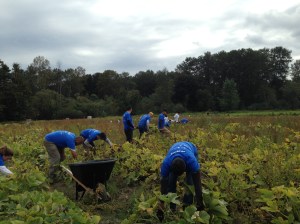
Chinook Farms in Snohomish, WA has, or rather had, a few acres of acorn squash it grows for charity. Girl Scouts planted it, the farmer tends to it, and United Way Volunteers pick it and crate it, and it is then shipped to food banks in the surrounding area. Microsoft’s CDnA group (Consumer Data and Analytics) had a cadre of volunteers to do so, of which I was one.  Acorn squash are delicious but their foliage is sharp and laden with micro thorns, I actually wore through spots of a new pair of leather work gloves and have an impressive rash on my forearm (where my “long” sleeve backed off).

The morning started with that crisp, autumnal chill we get in the Northwest that belies an Indian Summer; it was all turning leaves and wishing for pumpkin spice lattes as I drove the windy road into Snohomish. Arriving at the farm I saw some hundred-odd other blue-shirt volunteers, ready to go out and pick squash. Another hundred or so were the contingent from Nordstrom, in crisp white shirts. I signed the photo waiver and so somewhere, out there, there are photos of me with my group, wearing our blue t-shirts, dirty, smiling, posed in front of a pile of acorn squash.

IMG_1851
Pretty sure we didn’t do it right.

Our VP was in the fields with us, tossing squash to collectors; early on we had deviated from instructions and while we did have fairly neat rows of trampled-down, already-picked squash plants in our wake, our piles of squash (to be wheelbarrowed down to the shipping crates) left a lot to be desired in terms of neatness. The Nordstrom folks had symmetrically neat piles, as you would expect.

Several of the volunteers commented that this was hard work and they would thereby appreciate their brain-intensive but body-light regular jobs much moreso. I found this a little wry in terms of the layoffs that occurred the day before: some of us were already in fervent appreciation of still having a job. I mentioned that to my VP (read, 3 levels above) and he said, “That’s a horrible thing to say. Do you like your job?” I replied in affirmative, and I’m not sure that either of us got the point of where the other was coming from. When the sun poked out of the clouds and it got hot, some took to complaining a little more; they were shut down by the volunteer coordinator who pointed out we could have gone to clean the bathrooms in the downtown Seattle YMCA instead. Not a peep after that. I noticed one lady who never complained. She is 7 months pregnant, and was picking squash in the fields with us.

As the group drove away from the farm to the place down the road where free pizza and beer was promised, I drove home; I had a pile of email to wade through that I was (unashamedly) looking forward to. I had done my planned volunteering for the morning, but I still had that job that I love, and am still grateful for, waiting for me.

A Letter to the Girl at the Gym, Going Back to CalPoly

Congratulations! You’re going back to Cal Poly!

Oh, I hope you don’t mind. David told me. David is my trainer, and your trainer, and as you’ve been training with him it will come as no surprise that he shared that. The fact that you and I don’t really know each other somehow makes this okay, but I’m still not sure how the social convention of talking about others works (when it is and isn’t okay), so just understand he is proud of you and that’s why.

He said you came back because you didn’t make friends and no one was particularly nice to you your first quarter.

Well, first, let me congratulate you again, and point out that you are making a financial decision that will last the rest of your life, and that we need more women in STEM, and that since the American schooling system is trained to either drop you out or send you to college (no trades-person training, which really should happen), you picked the best route, really. I’ll do you the credit to assume you knew that.

That said, a word about the friends thing: You’re not in college to make friends, and the deck was stacked against you.

To my first point: college is widely touted as this friendship-making, bonding experience that late teens/early twenty-somethings will have, filled with parties, alcohol, clear skin, walking to class in your pj’s, Ramen dinners, learning the physics of beer pong, etc. Every college brochure has the following 3 pictures among others: one pic of a beautiful college campus with architectural or landscaping feature, one pic of what a graduate of this college will look like (cap, gown, diploma, smile), and one pic — and usually several more — of groups of diverse young people with big smiles doing varying things in and out of class.

Take it from me: friends are what happen in between cramming for tests, running to class, and sleep deprivation. Friends *can* happen in college, but they are not part of the curriculum or contract  you (and/or your parents) are making with the university. Speaking as someone who attended classes where some of the constituents CRIED because they got a 95% (that’s crying with shame, mind you) — and the class was graded on a curve — college classes, and particularly STEM classes, are competitive. While it is possible to be friends and competitors, it’s a difficult trick and usually requires more experience than the school system arms you with. (Remember, from Kindergarten to 12th grade, we are all Special.)

Friends do not instantly appear as part of your dorm room provision, and in fact most people I know who did stay in the dorms avoided their dorm mates. Not that they were bad people, or anything, just not their type. Also, since college is a different psychological playing field than high school was, the criteria by which people group themselves together and socially signal is subtly altered. Wearing the right clothes or doing your hair the right way will not automatically identify you with some particular group that you can meld in to. You will find, I think, that this is a good thing.

Which leads me to my second point: you were going to have a hard time making friends. Everyone does, but you in particular will. First, I agree that it is unfair. Second, I will explain: you are a tall, athletic blonde, with fine features, and clear skin. You have the brains to get into CalPoly. You are, therefore, the subject of envy on two fronts.

Most of us who could get into CalPoly (and I say us because I didn’t apply myself — in both senses of the word — but had I –again, in both senses of the word — I would have got in) were the ugly ducklings of our high school. We had thick glasses and our skin wasn’t clear and we “geeked out” on things before being a geek became cool. (Wait, does that make us hipster geeks?) We spent our high school — and some of us, junior high — lives being either envious of your looks, your social sphere, and your choices; or being mistreated by you or people who look like you. (Example: it was one of “your” group in junior high who did the “finger test” down my spine to see if I was wearing a bra, and then announced it to the entire lunchroom.)  There’s an entire subsection of high schools everywhere of folks who were like me, who pretty much cried every day they had to go to school for a given period (in my case, about a year) because being a teenager is awkward enough but the additional unfairness that is heaped upon everyone in those times just makes it more so.

Imagine our distaste, then, when we find out you had brains, too.

Even if you weren’t one of the locker-room bullies, even if you were super-nice popular girl (and we had a bunch of those, too — and those are the ones I can be Facebook friends with now, actually, because they’re the same and I’ve grown up), we still were going to Go To College and Everything Would Be Better. We wouldn’t be judged on our looks and would only compete with our brains, and especially, especially at a technical college, our brains would be the thing most appreciated.

And now we saw you had them, too.

There’s going to be reticence. There’s going to be envy, and comparison, and competition, and it’s going to feel a lot like that first part of Legally Blonde where the two characters — the blonde one and the brunette one, I don’t remember their names but the brunette is considered more smart and less pretty, naturally — are in the thick of it and the smart, less-pretty brunette (I think the quote was “not entirely unfortunate looking”) is picking on the blonde. The real and perceived inequities of high school coming back and asserting themselves on someone who looks like, but isn’t, the person they had to deal with.

Totally, completely, and utterly unfair. In retrospect I agree. (Did I do this? No. I slacked off. It wasn’t a better solution.)

So I want to give you this advice, because it was hard to make friends for me as well — in junior high and high school. And, as I have the clarity of some years, this is the advice I wish I had gotten, and/or followed:

1. Remember where you are, and why you are there. It’s 3.67 more years to go, which is a comparatively small part of your life: treat it like a job. Learn as much as you can, get a decent GPA. Come home to the friends you’ve made here, but don’t be surprised if they change — or if you do. It happens.

2. Make friends outside of college. Join the gym there, or a club, get a part-time job at a place whose products you enjoy. Keep your college life, and your personal life, separate, at least at the start. You will find them slowly merging, and it may take a couple of quarters or a year, but if you don’t require it as an instant presentment you will be fine.

3. Get an internship somewhere. This will help you when you graduate to show practical work experience. It also shows you that most of the world operates differently from high school and college, and while it is not the utopia most of us thought college would be, it is far better than college was. You’ll learn about the difference in expectations of the corporate world and the academic world, you’ll learn the value of a well-timed coffee break or how to multitask in a meeting. Possibly more importantly you’ll learn if that is what you want to do when you get out of college, or if you want to pursue a more academic life.

As you left I heard you tell David you’ll be back in November, to visit for Thanksgiving. I’m looking forward to the update. 🙂

Check

“Ok, close your eyes, hold still, and try not to breathe too much.”

This was the direction given to me by the twenty-something lady doing my hair and makeup. The process that succeeded that directive was airbrushing.

To me, airbrushing is something you do via Photoshop, after the photos are taken. Apparently makeup artists are getting in on that action, however, and I duly closed my eyes, stayed still, and tried very, very hard to breathe only as much as I needed to keep alive. To reproduce this effect at home, take one of those keyboard air-sprayer things, close your eyes, and spray it in strategic swaths over your face. That’s it.

In addition to micro-droplets of skin-shaded liquid, I also got to participate in fake eyelashes, which is I think the fourth time in my life I have done that. My opinion of fake eyelashes is that they look really great, and really fake. As the purpose of the makeup and hair was to make the pictures look good, and we were only having one round of pictures for this event, I did whatever the makeup lady said.

This event, to be clear, was my wedding day.

Having spent three relaxing, lazy days in Kauai (the Garden Isle, or as may be, the Chicken Isle), we now came to the part where we had to get dressed up (beach wedding == white linen), and in my case, have someone fuss over the femininity. Then we met up with our officiant and our photographer (and his wife), stood on Shipwrecks Beach in Poipu, said some very pleasant things, exchanged leis, exchanged rings, took some more pictures, and were done within an hour.

The boy spent a large part of that hour eyeing the lovely waves and trying to figure out exactly how he could put it to us that his part of the ceremony, and then pictures, was done, and could he go please play in them?

The remaining five days were equally lovely and lazy; the boys boogieboarded (ok, I did too) and we played on the beaches near daily. We did the obligatory shopping, we did the helicopter tour, we ate pineapple until the roofs of our mouths protested. We flew there and back in first class, and it may have ruined us for travel, forever.

So that is that. The deed is done, the pictures are taken: we go about the rest of our lives. And I don’t have to close my eyes, hold still, or try not to breathe too much.

Nick Galante Photography-2196