Beijing, Part II

After three days of meetings, 1:1’s, whiteboarding, catching up with my mentor, and amazing team lunches and dinners, I was on my own, for a day, in Beijing.

My hotel was in the “Silicon Valley” district of Beijing, in and of that the area is populated with many of the tech offices; Microsoft has two buildings there joined by a skybridge (which announces “Hi, I’m Cortana”). As I can easily get lost when I haven’t done my proper research and got my bearings, I elected for a day-tour on my one day off.

The night before I left I got a call at 10pm:

Her: “Hello, this is your Tour Guide. You need to be outside your hotel at 6:30am for your tour bus, okay?”

Me: “Ok.”

Her: “What time are you going to sleep? I will call you later with your bus number.”

Me: “I was asleep when you called.” 

Her: “What time are you going to sleep?”

Me: “I was already asleep.” 

Her: (Pause) “Oh. I will call you at 6am tomorrow to tell you your buss number.” 

Me: “Okay.”

Her: (Demanding) “Why do you not want to go to the Great Wall?”

Me: (Nonplussed) “What??”

Her: (Demanding & Impatient) “You signed up for Forbidden City and Summer Palace. Why do you not want to go to the Great Wall?”

Me: (Defensively) “It’s not that I don’t want to go, it’s that I only have one day, and my friends told me to do this. 

Her: (Warning) “Are you sure you don’t want to go to the Great Wall?” 

Me: (Too tired to care…)“Maybe next time.” 

Her: “Okay” (hangs up)

Thanks to the aforementioned jetlag/insomnia I was up at 4am, answering emails and toddling around. Breakfast is not available at the hotel before 6:30am so I walked over to the 7-11 and purchased Mystery Breakfast and orange juice, both of which were decent. At 6:30 I got on the bus. I was the first person on it.

After 3 more stops the bus was half full, including a woman behind me who appeared to be retching into a plastic back (based on sound). I was relieved when the tour bus stopped just outside the Forbidden City and Linda, my Tour Guide (from the phonecall the night before), got on and said “You’re from the Crowne Plaza, right? Come with me.”

It wasn’t hard to tell, I was the only non-Asian person on the bus.

With Linda I joined up with two other gents, both from Singapore, and realized that we were on the “English Tour Guide” tour. We walked to the Forbidden City, along one side, and then along the moat (it’s about 50 meters wide). Linda pointed out the four gates into the City (North/South/East/West) with their ritual uses (West is for dead people to go out, only the Emperor could use the South—except on her wedding day the Empress could, too), the four watchtowers in each corner, and the large gate doors with 81 metal studs in them (9×9, because 9 is the highest single-digit number and the Emperor is the highest person, aside from their deity). We walked through the South Gate (neaner, neaner Emperor) and into the first part of the Forbidden City.

(Side note: as our Guide returned from purchasing tickets a young Chinese couple approached her and asked her something. She turned to me: “They want to take your picture.” Me: “Wha…why??” Her: “They haven’t seen a white person not on TV before”. Me: “Um.. okay…” Somewhere in China I’m on an iPhone.

The Guide explained to me that they were not from Beijing, and that no one from Beijing or Shanghai would even care. But they were tourists, too, and apparently white people are on the list of things to look at.)

The Forbidden City is both larger and smaller than you’d expect. The first piece we walked into can best be described as a large courtyard, with buildings on each side. Beyond those buildings are other areas/courtyards, with more buildings, of varying significance.

“You see that building?” she said, pointing to a single-story building (don’t let the description fool you, a single-story building in the Forbidden City is about 3 standard US stories). “That building is NOT important.” That building had ornate lacquer, multiple pillars, gold-leaf dragons embedded in the top around it, and impressive marble stairs leading up to it. (Then again, so did every other building in the complex).

“It is NOT important because it only has 1 level. In Ming and Qing dynasty, you have 1 level for ‘regular building’. Two levels for ‘Emperor building’. And three or more levels for Temple. Emperor needed more levels than regular but could not have as many as God.”

We walked from one building to the next, marveling at the ornate carvings and the excellent restoration work that had been done. “See that building? Not important. Emperor would stop there to change his robes.” This would become a recurring theme: “That building? Not important.” I have many, many pictures of these buidings (both non-and-important ones).

After walking all over the Forbidden City we went to the Temple of Heaven (“See? Three level. Very Important.”) where I discovered that the architecture was indeed beautiful but I didn’t want a picture of the inside bad enough to withstand the jostling that was clearly de rigeur. I walked around the perimeter instead, taking pictures from the hilltop that the Temple sits on.

After this we headed to the Pearl Market, a government-run facility that aims to expand China’s burgeoning cultured freshwater pearl market. These are not the “Rice Krispy” pearls of my memory, but beautiful, round pearls that come in five colors: white (everyday/purity), black(indpenedence), purple (for romantic love), pink(friendship), and gold (dragon lady/super fancy). Be warned: you walk in and you get to help them open up an oyster and see the cultured pearls within, but you also are then followed by your very own salesperson for the rest of your time in the shop. Even if you’re just looking. The variety is impressive and I bought something (hey, I was in China!), including my first (and only) Chinese Diet Coke.

Chinese Diet Coke tastes exactly like American Diet Coke, which is surprising. As the male person remarked, “Diet Coke doesn’t even taste the same in Canada!”

After this we had lunch that was right next door to a fish market. Most of the items for sale there were what you’d see in any decent fish market in the US, with one notable exception.

We then went to the Summer Palace. The Summer Palace was about 40 minutes away and the van got quiet with sleepy tourists, which was good. When we arrived we were refreshed and the guide explained that the lake which bordered the Summer Palace was artificially made—or partially so. “Half was here. Half was made. They took the dirt from the half that was made and made that hill there,” she said, gesturing to a hill with a temple atop. “This was a present from the Emperor to his mother.” It’s pretty impressive when you take into account the size of the lake and the size of the hill, never mind the actual building architecture. As with any tourist attraction, the buildings were laced with gift shops and gift stands, and crowded with people much as the last two spots. “All the children are out of school for summer,” she said. “Now is the time when all of the tourists are here.”

tourists, like us :)
Tourists, Like Us 🙂

Our final destination for the day was Mr. Tea, a teashop. We were treated to tea service and learned how to properly drink tea (it depends, apparently, on what kind of tea, if you are going to slurp it or “chew” it or sip it). We learned how to hold the teacups (ladies: thumb and forefinger at the top, middle finger to the bottom, ring and pinky finger extended; gents: thumb and forefinger at the top, middle finger to the bottom, ring and pinky finger curled in under the cup. If men do it the “ladies’” way, they are considered “girly”. If ladies do it the men’s way, they are considered to be “dragon lady”). One variety of local tea is called Pu-er tea, and it’s very good; as with our other shop-stop this one meant we had a shopping assistant at our very elbow, coaching us on what else to buy. I noticed in both places there was no real dickering but they really emphasized the upgrade (“Don’t you want a necklace with that? What about when you go to a party? You need to be dressed up!”) (Trying to explain to this very delicate, feminine creature that I do not go to parties, and that I spend the majority of my time either at a computer or in equally unglamorous events seemed moot.)

I got back to the hotel at about 4pm, tired but happy. There are other tours available at the hotel and of course a ton more to see, which I will do on my next trip.
Nuts

Nothing beats accidentally eating a nut (for a nut-allergy person) to give an exciting kick to a vacation.

I write this at 35 thousand feet above the Pacific Ocean, where blue and clouds stretch as far as the eye can see, warily sipping my coffee and hoping the remediation I put into place for said nut, worked. Because there is no wifi on the plane, if you read this, it worked.

As part of our trip we were given first class seats by my newly minted father-in-law (thank you Gary!!), and not only is there fancy breakfast on the plane in first class, there is fancy two-course breakfast. I opted for only course one: fruit plate and a pastry. The pastry that arrived on my fruit plate did not have immediate visible nuts; it looked like a bran muffin. I eyeballed the male person and boychild’s pastry, which looked like a pastry (complete with icing and almond slivers), and then eyeballed the innocuous-looking bran muffin. I asked the cabin steward if it had nuts and he said, “Hm, let me check”, wandered off into the kitchen, wandered back and said, “No, it doesn’t have nuts.” I asked the male person to take a bite out of the muffin to test it, and he said he didn’t taste any, and the lady on his other side chimed in that it was “just a bran muffin”. I cut the muffin into four pieces, saw no nuts, and proceeded to throw caution to the wind.

You think I’d learn.

About six minutes later I had eaten most of the muffin when the telltale “crunch” happened. Leveraging a couple of napkins, I declined to swallow, and then sat back in my chair wondering if, in the earlier bites, I had gotten one. I sat and wondered if I was being silly, if I was imagining things, if the itchiness in my throat really was because we slept all night with the AC on (after all, it was itchy when we drove to the airport). I gave up and decided to settle the matter once and for all.

The first class loo has orchids on the little table, and is infinitely cleaner than the economy class loo.

Aside from this, the flight has been an absolute treat. Coffee is served in real mugs, juice and water are in real glasses. The seat width accommodates me and should I so choose, my bag; the legroom is luxuriant. When we had got to the airport we were the beneficiaries of Microsoft’s dedicated check-in line (in the first-class section but leveragable even if you are not flying first class) and expedited security. I can complain about the lack of wifi I suppose, but I just don’t think that can happen in trans-oceanic flights. Besides, this is the first vacation I have taken in 11+ years where I do not have my work laptop, nor do I have work email on my phone (I disconnected Exchange from my iPhone). I had planned, right up to the end, to bring my work laptop “just in case”… but the unfortunate reality is my laptop bag can carry either two laptops, or one laptop plus necessities. The decision was made for me.

Which brings me to some real introspection as to why I (and many of my compatriots) feel the need to bring a laptop with me and/or stay connected to work when on holiday. My father had an interesting point: the kind of people who need that connectivity usually do so because they either “live” their work, or they feel they “have” to in order to make up in quantity what they lack in quality. (If you’re under the impression that my father is an extremely frank talker, you’re right). He has a point: I’m guilty of both. In the case of the former, I usually take a job with the view that someone is paying me to do something, and it is a reflection of my name and reputation the work I put out. So I get emotionally invested in work, at least to a degree, which I am certain has shown itself in one or more meetings or email missives. Alternately, I have enjoyed extremely flexible schedules at these positions, which leads me to wanting to demonstrate accessibility in return for those flexible schedules. I’ve had people marvel at email response at 3am and 7am and 11pm; that is a combination of drive, excitement about the product/project, and raging insomnia.

What does it mean, then, that I can blithely leave my work behind for nearly ten days? A certain degree of comfort: I am working in a company where they trust me to be on deck when I’m on deck, and they seem to actually want me to unplug when I ought. If they really, really need to get ahold of me, it’s not to build a PowerPoint deck or fix a TFS ticket or build a spreadsheet, it’s going to be so they can rent by brain (which they can do via cell phone, in an emergency). This has not always been the case and I’m both excited and nervous at the prospect.

Or maybe that’s the nut.

Beijing Airport

If you’re going to be stuck in an airport longer than you expected, Beijing Terminal 3 isn’t all that bad.

I arrived 3 hours early courtesy of my reliance on the calendar set by corporate travel booking. It turns out when you have a 4pm flight, your corporate travel team books a calendar for 1pm, because they figure that’s when you need to be leaving your hotel to go to the airport. My jetlagged insomniac brain saw that my flight left at 1pm, and I got here (courtesy of no-traffic Saturday morning) at 9:30am. Oh well.

Air Canada (my carrier) would not let me check in until 1pm, so that meant I had some serious time on my hands before I could get to the gate. Fortunately, there’s a variety of eateries, gift shops, and services *before* security, so I’ve spent some time (and some yuan) while waiting. I cruised the gift shops, of which there are about 10 (of varying degree of price: there’s a Chinese Gold jewelry shop and there’s the local equivalent of a drugstore, and everything in between). These are the kind of airport gift shops where if you wanted to score a dust collector or a silk scarf or a set of chopsticks or a stuffed panda bear, you’re set.

If you go upstairs from the ticketing gates you will find not only a Burger King (no thank you), but also a tea house/massage service. You can get a foot massage, a back massage, and/or tea. I opted for all 3 (again, plenty of time to kill). With my complete lack of Mandarin I pointed to the English Words saying Foot Massage and was beckoned by a nice lady in a uniform down a hallway, another hallway, and into a wood paneled alcove. There we turned through a maze of a hallway past individual wood-paneled massage rooms, until we got to mine. I was beckoned to sit, and then I was brought a cup of sweet water. As part of the foot massage they soak your feet in hot water, and I do mean hot: it’s the kind of hot where you have to convince yourself they couldn’t possibly have expected you to put your feet in something that would scald you.

There I sat, while my feet turned an impressive shade of scarlet, and a man came in.

Oh, there’s another cultural shift.

For me, massage has usually meant women for women, and women/men for men. Or at least, I’d be asked. There was no asking here, but then again there was no nakedness (even for back massage). They drape a light towel across your neck and shoulders and go to town. If you have a knot when you walk in, you do not have a knot when you walk out. You can wince and gasp all you want, too. The nice man with the scorpion tattooed on the inside of his wrist does not care, and he will take care of it.

By this time I had a roommate, a nice lady who never got off her phone the entire time she was in the room. I figured I should suck it up for her benefit, too.

The foot massage part was even more robust; there were pain points and more pain points, and something that felt not unpleasantly like they were cracking your toe knuckles. I don’t know a better way to put it than that. After a while I gave up and got my phone out too; Sudoku and foot massage ftw.

Then I had tea.

They have a special tea here in Beijing, called Pu-er tea. It looks like black tea but is not as strong, and has purported healthful properties. As part of tea service they give you a little plate of sunflower seeds and plastic-wrapped biscuits, neither of which really interested me, and then they make the tea in front of you, leaving you with a tiny cup and a glass teapot to pour from. That’s where I’m at right now, typing away on the local free wifi, waiting for my airline to open.

Some other travel tips for you:

  • Local hotels will tell you it costs about 600Yuan to get from their hotel to the airport (especially if you’re in the “Silicon Valley” district). The cab is less than 200Yuan, but it’s cash only (they can give you a receipt).
  • Not all of the toilets are the standard Western variety. There’s a few squat-style ones, but they’re usually marked on the outside of the door so you can tell before venturing into the stall. This is true not only for the airport but for restaurants as well.
  • You get a better conversion rate if you use your credit card or cash, than if you use USD in the airport. Exchange rate in the airport gift shops is 6Yuan to 1USD, for cards and otherwise you get 6.2Yuan to 1USD. Best to get your Yuan stateside and come prepared.
  • Most restaurants will take credit cards, but small shops and smaller eateries will not. Also, not all US credit cards are accepted, and we had a devil of a time using our Corporate Amex in anything but our hotel and very large, established restaurants.
  • American branded food (e.g., Burger King, Hagen Daaz) is more expensive than local fare and way more expensive than back home. You’re in Beijing, you don’t need ice cream.
  • Almost everyone knows some basic (and I do mean basic) English: hello, this way, please, etc. However for the most part service staff know these words as symbols and are expecting a set of standard responses. For example, I was asked this morning, “Would you like some more coffee?” To which I replied, “Sure, I’d like a little more coffee.”  Because I didn’t say “yes” and instead used “sure”, and because I added “a little” in there, the look I received in response was nonplussed. I switched it to “yes” and that sorted things out. The service staff’s accent is usually very light for these practiced phrases, and you will be lulled into thinking you can have more robust conversations with them (e.g., “Do the biscuits have nuts?” never got a real response because I couldn’t make myself understood). (I didn’t eat the biscuits).
  • Most hotels can arrange a tour of the sights (which I did). However in retrospect if I had spent a little time planning (if I had had it) with a subway map and done some research on the sights, I could’ve easily seen it without going with my little group. I would not have got the educational bits from the tour guide, but I could have read those in advance, as well.
  • The air does indeed get smoggy. I was fortunate to come in after a rain so my first 3 days were gorgeous, clear, and blue. By the fifth day it looks like we’re in a cloud. Drinking tea helps the throat soreness you get from this.
  • If you love your toiletries – especially deodorant – bring them and do not count on buying them here. I ran low on deodorant while here and thought I’d just pick up another one to be covered (no pun intended) – good luck with that. The local 7-11 had toothpaste, etc. but no deodorant. A bing search for “Is there deodorant in China” will get you humorous and informative results.
  • Don’t eat the street food (at least, we were cautioned by our local friends not to do so). DO eat with an open mind. I have had several different kinds of critter and a variety of vegetables, and it was all great.
  • At the airport you need to fill out a little yellow and cream colored card, usually available on tables right before you walk up to customs and immigration. If you miss it and get all the way up to the person on the other end of the glass, they’ll send you back to get one and fill it out and then get back in line… which is usually long. So, read all of the signs and look for the little cards.
  • Once you’ve passed security (on your way out from Beijing) the shops are predominantly duty-free, and high-end souvenir. There are a few places to eat and, if you really want one, there is a Starbucks.

I have another post, in which I’ll go through my “tourist” day here in Beijing, but it’s now 1:10 and I can finally check in. Woo hoo!

Beijing, Baby!

One of the advantages to having chronic insomnia is that when you travel halfway around the world and you wake up at 2 or 3 in the morning, it (in itself) is not a foreign thing. It also means you get through jet lag a lot faster, because you’re used to sporadic sleep.

I am typing this in my room at the Crowne Plaza in Beijing (the one on Zhi Chun road, if you want to be specific… there’s 3 or 4 others). I will not be able to upload it to WordPress until I get to work, though, as I am behind the Great Firewall, and one of the things you do not get to do here is engage in Western social media. Twitter, Facebook, Swarm/Foursquare, WordPress, etc. are all tabled until I can get into the office and leverage their VPN. As it is nearly 5AM and the pool I intend to swim in this morning doesn’t open for another hour, let me show you around what I’ve seen thus far.

(NB: when you travel for work, you spend a disproportionate amount of time in a hotel and in an office or conference center. A lot of this is going to essentially be skewed by that.)

First, the airport: It reminds me of a cross between Heathrow, Charles de Gaulle, and Vancouver. Think great long hallways sided by glass on one side (to the outside) and art on another, multiple long stretches with those flat conveyor-belt people movers, from the gates to a large central area filled with meandering, lost people and a variety of signage in both Chinese Traditional and English. I was really surprised at the volume of English, because it was not only in the directional signage (Parking, Exit, Baggage Claim, etc.) but also in the ads. But hey, we’re in an Airport, so that’s fine.

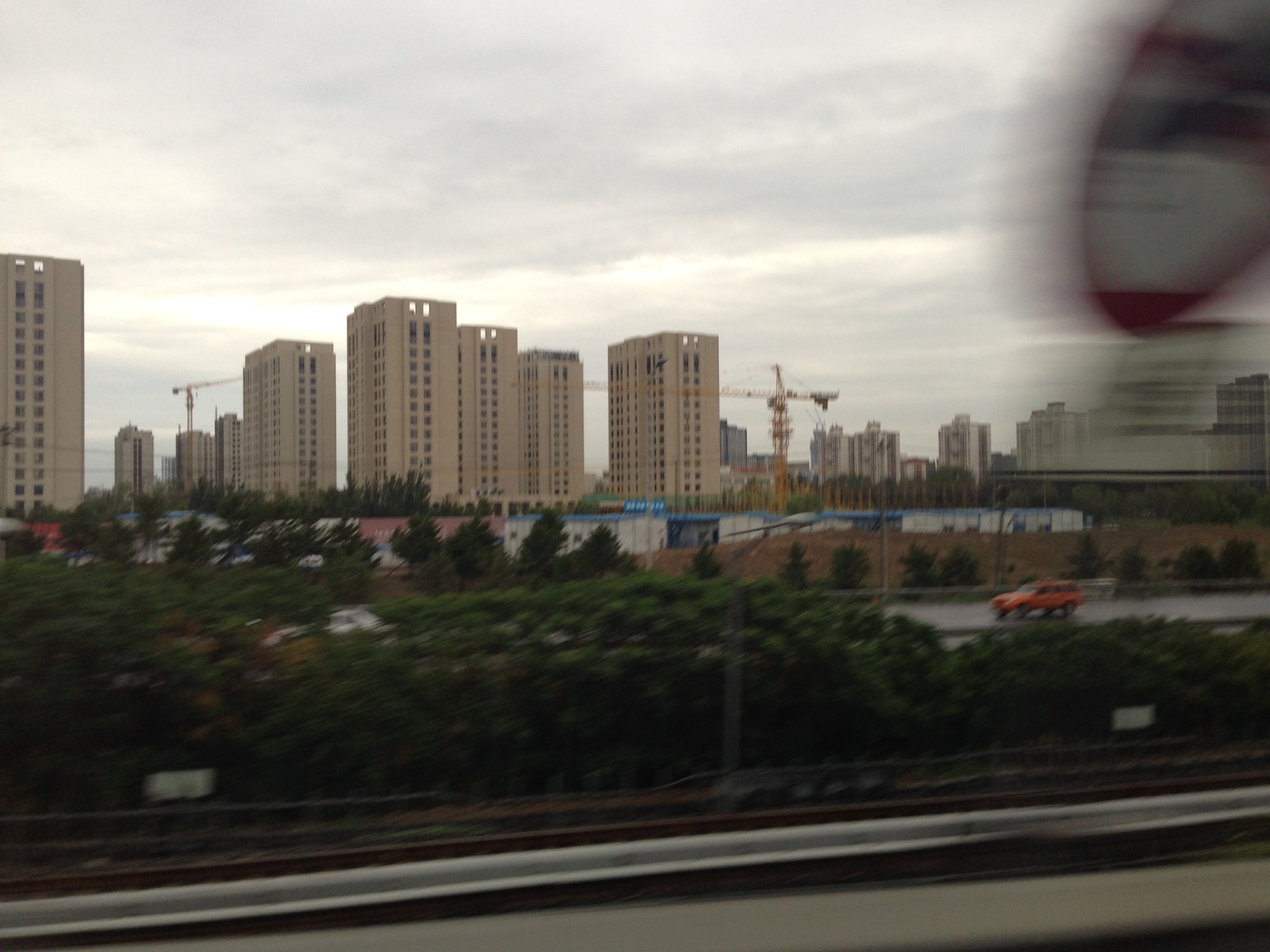
beijing_buildingsMy hotel transfer was in an SUV driven by a gruff man who said nothing (in Mandarin or otherwise). Thirty minutes got me to my hotel and I got to see the Bird’s Nest on the way in; the thing that really impressed me was the volume of high-rise apartment complexes. I am not exaggerating when I say I probably saw more than a hundred of them. The architecture of these buildings is pretty homogenous; tall, cream-colored buildings with uniform portrait rectangular windows, flat faces, only a select few apartments have balconies.

Many of tbeijing_boxeshe windows have what looks like an air conditioning unit but installed below the window (not in it), I found out later that those are the exhaust motors for the wall-mounted air conditioning units on the inside.
The best way I can describe Beijing is to take the relative building heights and proximities of New York City (so, very high, very close), mix it with an expanse the size of Los Angeles (so, very wide), give it infrastructure similar to what you’d see in Phoenix (wide roads, wide sidewalks), put in architecture that resembles both London (great tall glass buildings with architectural arches or curves) and the Eastern Bloc (tall grey or cream colored drab functional buildings), slather everything with Chinese Traditional characters in a variety of fonts and colors, and then add the people.

Lots and lots and lots of people.

Those nice, wide streets are crammed with a variety of vehicles (bikes, motorized and not; taxis; foreign and domestic autos) and people. Much like Manhattan, the guidance on crosswalks seems to be largely based on judgment rather than any actual signaling device (of which green man purportedly means go, red hand means stop). The brick sidewalks are crammed with a variety of people (male, female, old, young, professional, etc.). Street vendors have blankets on the ground from which you can purchase a variety of cheap knicknackery, there is also street food which we were cautioned (by local friends) not to eat. The subways are efficient and much like what you’d experience in any real city, and they are air conditioned. Personal space is not a concept people are familiar with here.

In the three days I have been here, the air has been clear and clean, thanks to a thorough rain on the morning of my flight. I’m looking outside my window though and I can’t see the sun rise, even though it’s perceptibly lighter. I can’t tell if what I’m looking at is smog or real clouds, but I’m sure I’ll find out later on my walk to work. The smells largely are defined by where you are at, so along one block you’ll smell a variety of food smells, along another you’ll smell a variety of not-food smells. Deodorant seems to be optional.

My hotel clearly caters to Western visitors: every electrical outlet in the room has converters built in, both for US and Europe (including UK). And I do mean every electrical outlet: the ones at the desk, the ones in the bathroom, the ones on either side of the bed, and even the one in the closet. If you’re staying at the Crowne Plaza here, you don’t need an adapter.

beijing_privatepotty
Ain’t no potty like an East coast potty.

The bathroom is roughly 40% of the room size and features a separate toilet (like, it is in its own glass room), shower (own glass room), and tub large enough for 2. Toiletries include things like dental hygiene kits, shoe shine kit, etc. My room has two gas masks so if the air quality gets super bad, you’re covered.

As you go downstairs to breakfast there’s a large fish tank to view, complete with Arrowanas and koi that are larger than them. The breakfast buffet is the sort that anyone can find something they eat (e.g., vegetarians, picky Westerners, adventurous foodies, etc.). It’s my goal to try everything before I leave but I’m not sure I can.


The volumes of food here are insane.

Granted, we are doing “team lunches” and “team dinners” which means eating in a variety of really nice restaurants, at really large circular tables. I have learned that you have two sets of chopsticks – one for serving yourself (so far, they have always been brown with gold handles), and one for actually eating with (black with silver tips). Sometimes there’s a serving spoon, other times there is not. We surprised our local coworkers here by the fact that we could use chopsticks. In these cases, the food has been served ‘family style’ and has ranged from mild and sweet to “I don’t have any sinuses anymore” hot. I promised them I would try everything and I have, which sounds more adventurous than it is. No one has ordered the sea cucumber yet (it is exactly that – take a sea cucumber out of the water, cook it as-is, dump it in some soup, and serve it… just lying there. Not sure how you eat it, it’s not even sliced.) But I’ve had organ meats and the like, and everything I’ve eaten has tasted wonderful. After the first day our local friends decided they didn’t have to haze us.

Food pricing is another interesting thing. Case in point: yesterday’s lunch was 10 people in a high-end restaurant, 10 different dishes plus tea and a blueberry yogurt drink thing (tasty!), and we walked out the door for about 530 Yuan (read, about $87). The ice cream we had later on in the afternoon from the Hagen Daaz cost more than that on a per-person basis (about $10—and it was not grandiose size).

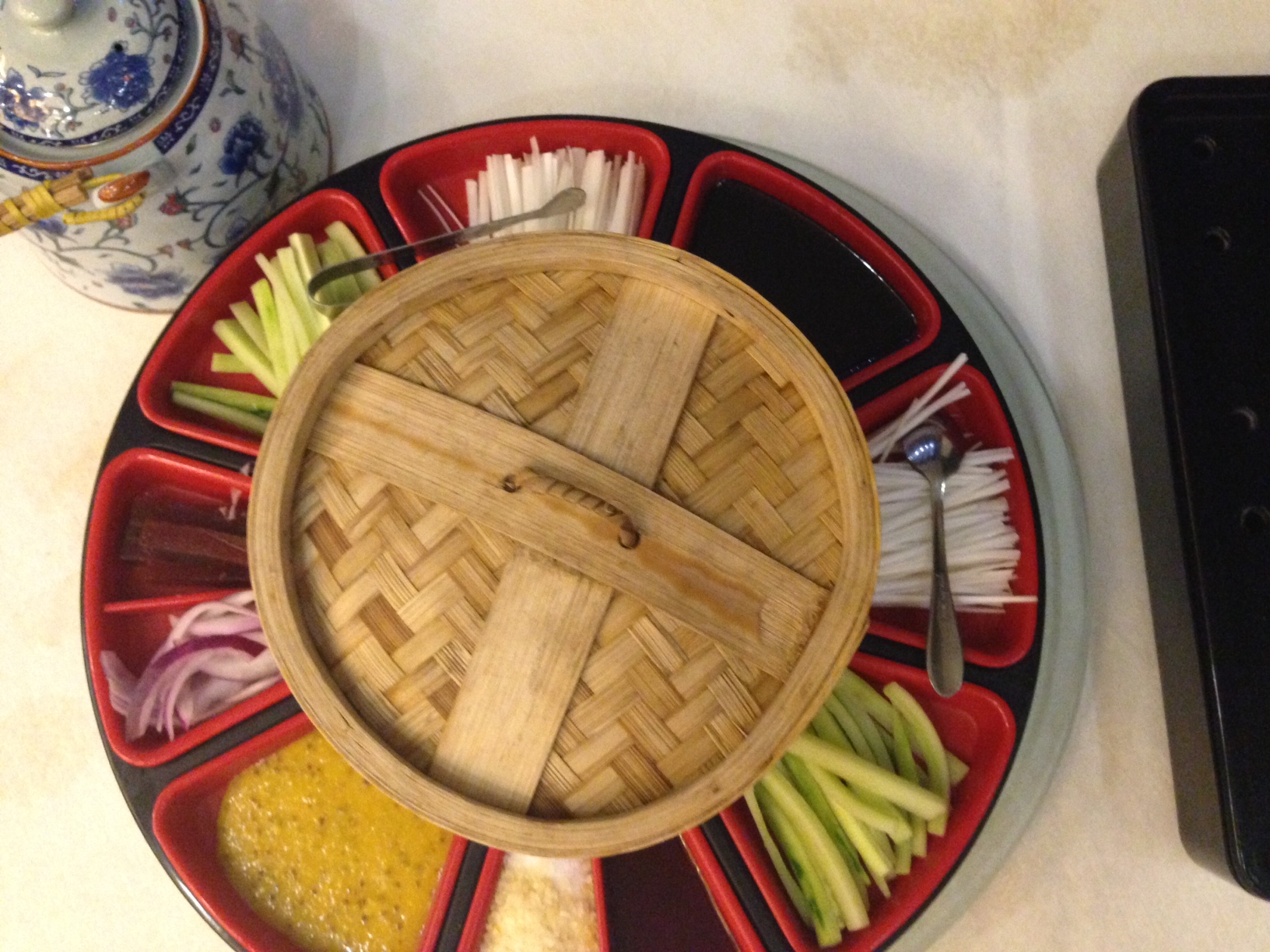
beijing_quackEating is almost a sport here, although we learned you do not eat all of the food (otherwise you are indicating that you were waiting too long and got too hungry, and/or your host/ess didn’t supply enough for you). I don’t think we could have eaten all the food if we tried. I’m taking advantage of the gym here daily (nice – 3 treadmills, 2 ellipticals, 2 bikes, free weights, and 6 weight machines) and coupling that with our daily walks to/from the office should hopefully undo some of the gastronomic damage. There’s a scale in the bathroom.

I have one more workday here – barring the fact that the recycle bins have small descriptions of what constitutes as recycleable both in Chinese and in English, you couldn’t distinguish this office environment from any other that Microsoft offers in Redmond – and then tomorrow I am taking the day off to go do some sightseeing. With my stellar sense of direction (I can get lost in my hometown) I am going to rely on the hotel’s package tour that it offers, so I’ll pen a follow up on that.

In the meantime, I’m going to go swim some laps. Last night was Peking Duck.

Avoidance Behaviors

When I first came to work for my current company — you may have heard of them — I was treated to a day-long new employee orientation, followed by a series of prescribed video tutorials that covered a variety of topics, including security, the law, navigating the company, benefits, etc. One of the more pleasant surprises was a “top 10” list of suggestions for a new person in Engineering — which I qualify for, managing an engineering program.

I don’t remember 9 of them, not specifically.

The suggestions were like most “work efficiency” things, as you read them your reaction is one of “oh, of course”. Things like limiting time spent on email, and the like. The only one I remember specifically was a Mark Twain quote: “Eat a live frog first thing in the morning and nothing worse will happen to you the rest of the day.” The explanation provided was along the lines of, “We all have things we have to do that we’d rather not, so if you get them done and out of the way first thing then you’re better off.”  This is patently true, but a difficult thing to practice for days on end.

For some people, attending to email is their frog. For others, it’s having a difficult conversation with a coworker, or using a particular piece of software. For me, I seem to be having a definite reluctance to draw up a particular piece of architecture, not because I think it is a waste of time (it will be a very useful tool in a discussion) but because I have to deliberately draw up a comparison with what I feel is an inferior product.

Telling an engineer their design is inferior is akin to telling a woman her baby is ugly. It isn’t nice, and it doesn’t give you the warm fuzzies. No one wins. The difference though is that the baby’s ugliness impacts no one (except, possibly, the baby) and a poor design can impact many people. Further, the impression I have that the alternate design is better is my own impression, through my own vision, and may be entirely wrong. Being someone who really prefers a black-and-white approach (binary, Boolean, whatever — there is yes and no, no maybe) means that this is a frustrating limbo.

And so I’ve been avoiding it.

I don’t have much time with which to avoid, though, as it is due today (self-assigned yesterday) and I do want it done. My personal outlook is further complicated by a brand-new sore throat, the kind which feels like you swallowed sand.

In the roughly 24 hours since I assigned myself this project, I have:

  • Attended four meetings, unrelated
  • Answered/categorized 50-odd emails
  • Updated a couple of unrelated documents
  • Checked a bunch of other unrelated boxes
  • Slept 10 hours — needed it, as the night before I slept 5
  • Wrote this post
  • Ate more than my fair share of Triscuits (rather than eating out of boredom, I eat out of avoidance, something the scale does not appreciate)

This thing will take me all of about forty-five minutes to do, and yet I somehow found time to do all of those other things. It will get done — but really, I should’ve eaten my frog this morning.

It would’ve left me too full for the Triscuits.

Pink and Blue

I was at a child’s birthday party/dinner last night and we were discussing pedicures. One of the boys was running around with his nails done and I had stated that I had asked my son if he ever wanted to do that (for he was welcome to come with me) to which he assertively said “no”. When I retold the story I included my pointing out to him that they have “plenty of ‘boy’ colors” to which a friend of mine (appropriately) chided me with the question: “What is a ‘boy’ color?”

She and I both knew the actual text of the conversation was my attempt to clarify to my son that if he wanted to have his nails done a color other than pink or red that that was available these days, and that my use of “boy” was to appeal to a child who had already had societally-driven color choices drilled into him; and that her attempt to tease me was the sort of thing friends do. I am sexist in some ways but not that one. That said it did open the wider discussion of gender color stereotypes, which is one reason I like hanging out with the people I hang out with, because we didn’t have to devolve into a contrived political correctness or a stunted conversation about color choice equality.

To provide some background: one friend has a boy and girl each, another has the same, a third has two girls. I have one boy, and elect to dote on girls by proxy. But this conversation, plus a recent review of the Mindware catalog, got me thinking.

It’s no secret that the toy aisles of Target, or Toys R Us, or really any other mainstream store, are segregated into three types: “Gender Neutral” toys, “Boy” toys, and “Girl” toys. The “Girl” toys aisles are helpfully marked by pink signage and include things like dolls, baby dolls, Barbie dolls, domestic dress-up games, and (possibly) Pink Legos. The “Boy” toys aisles are manfully black and blue and red and include Nerf guns, trucks, traditional Legos, new movie-themed Legos, and Legos that look fairly militaristic. In the middle you have card games, balls, and Slip-and-Slides.

Why do my friends’ daughter’s Legos need to be pink? They are defaulted to build houses and ice cream shops, fine: you can build a perfectly serviceable house out of red and blue and yellow Legos, because we all did that when we were growing up. And if they are red or yellow or blue you don’t have to build a house or ice cream shop, you can build a rocket. Or a scale model of the Revolutionary War.

Why does her son’s Medieval Lego kit have only armed soldiers? Anyone who spent time in their History class knows that most of those soldiers were buffeted 10:1 by peasantry, either in terms of someone to go get the grain that fed them to someone who took care of the horses. There’s no queen, no princess, no baker-lady (for gender roles *were* explicit in those times and so Lego would be perfectly correct to have them in a set identifying as that part of history). But no females of any kind can be found in the kit. This very manful Lego kit is full of manly manliness and action. Girls need not apply.

The Star-Wars new Lego minifigures this year at Target have two (2) females out of what looks to be about 50 new minifigures. They are Leia in the gold bikini and Padme in the ripped-midriff shirt. Not Leia in her Cloud City costume, or Padme in her full regalia (Lego has found a way to make capes, they could’ve rocked this). (If you go to lego.wikia.com you can see the full minifigure line-up, and there are plenty of other female Star Wars minifigures. But they’re not on display at the Target.)

Why must Goldieblox, that bastion of gender correction in educational toys, be pink for girls? The whole point to Goldieblox was to get girls interested in engineering, to rail against the pink conformist aisles of toys for girls. Why, then, is it pink? Why are the cookware “play sets” for children almost always manned by a girl? My son loves to cook. But the photos on the box are clearly stating that this is a largely female domain.

While there are darned few pink toys in Mindware, there are far more boys in the pages of toys that are about engineering and far more girls shown next to the beading kits. If we can’t get our arched-brow, intelligent-snowflake-producing toy catalogs to play fair how do we ever hope to rescue our girls from the clutches of Barbie?

From the 20’s to WWII, the color “ownership” between boys and girls was inverted: boys wore pink and girls wore blue. Before that children wore white (which, if you think about it, is practical as long as you have a ton of bleach lying about). After WWII this reversed and we have the color “preferences” we see today. With all the challenges our kids have and will have (underfunded schools, bullying made easier via the internet — and this is not just kids, as adults have been doing that for years) can we please not heap upon them color “correctness”?

When you’re first pregnant the question you are asked is “do you know yet if it’s a boy or a girl?”  Some parents elect to make it a surprise and there’s that moment of “discomfort” for the families because now they “have” to shop for yellow or green baby gear. I honestly don’t think the baby will care if s/he is housed in blue or pink; the larger purpose is the social signaling device for this tiny creature to his/her audience as to what his/her gender is. I’m considering making onesies for babies that say things like “Manly enough to wear pink” and “Girly enough to wear blue” just to poke fun at this.

We live in a country of astounding wealth and opportunity and we have larger problems than the color or gender appropriateness of toys. The only way to shape and change the offerings is to vote with your dollars; it’s effective but it takes more patience than some of us have.


On the Naming of Me

My name is pretty unusual, in and of that I’ve been challenged by telemarketers, customer service people, and baristas alike that “That can’t be your name” or “What’s your real name?” (As if the sort of person who gives out a fake name would abruptly turn around and provide a real one). My name is in fact Bobbie, although legally it is Roberta; the only people who call me Roberta are telemarketers, teachers, and attorneys.

Per Wolfram Alpha, fewer than 200 people each year are given the name Bobbie (as a given female name – and yes it does say it assumes Bobbie is female). Less than 1 in 3331 people have the name, and the most common age for a person with the name Bobbie is 76 years. (Roberta clocks in at much the same, with 1 in 1823 people having the name and the common age is 57 years).

So it’s safe to say “Bobbie” is an unusual name, and that is that.

Over the years my name has been mangled quite a bit, from the masculine “Bobby” to the alternative female “Bobbi”. I also oftentimes get the email typo of one more o, one less b; for the most part I choose to ignore these and hope the sender goes away. That said, I wasn’t really particularly particular about how people spelled my name (with the exception of that last) until I read Freakonomics.

Freakonomics has a pretty good chapter on Correlation vs. Causality, particularly around naming conventions. The main anecdote is about a man who named his sons Winner and Loser, and the indication that the son named Loser had an extremely successful life, whilst the son named Winner had an extremely unsuccessful one. There is no causality in naming. However it also had a second anecdote, and a study, around names given to female children. Specifically, names that one would associate with strippers.

The idea was thus: if I name my daughter, say, “Bambi” or “Sugar” or something like that, am I dooming her to life on the pole? The short answer is no, you are not. By virtue of naming your daughter anything like that (there is a third indication of a daughter named Temptress who indeed had a pretty name-similar life) you are not going to ensure she ends up with a job whose uniform consists of two ounces of elastic and slightly more than that of glitter. But there’s still a good chance it will happen. Why? Because the parent who names their kid something like that is also probably not going to make sure she gets home in time for a curfew, or is getting her homework done. It’s the correlation – the fact that a parent who names their kid something like that isn’t likely to be hammering on the grades – rather than the causality that drives the preponderance of “Crystals” and the like to the pasties.

As part of this chapter in Freakonomics, there is a list of the top 10 names found amongst strippers at time of publication. The name “Bobbi” – with an “I” – is on that list. The name “Bobbi” with an “I” has a common age of 39. That means those Bobbi’s were born in 1975 or thereabouts, and Freakonomics was published in 2005, with data from studies probably the year previous, and so I think it’s entirely reasonable that their stripper population was about 29 at the time.

Since reading that I’ve made it a point to educate people on the value of the “e”. I don’t look good in glitter.

State of Education

I was born in California, and the first 12 years of my life lived there. The summer before my 13th birthday we emigrated to Washington, all six of us: my four parents, my brother, and I. Up until then we had gone to private school (in my case, religious private school) because my parents wanted to keep us out of the blackboard jungles of southern California.

When we arrived in Washington State the public school system was actually pretty darn good — the fellow students in my junior high were, for the most part, atrocious (as all junior high kids are) and my social register was somewhere beneath pond scum; but the educational offerings, while not as good as a private school, were pretty decent. My brother and I were as challenged as we wanted to be (which became “not much” and so between parent teacher conferences and report cards, the continual theme was “Bobbie could do so much better if she just applied herself”.)

As a twelve to seventeen year old student, I did not pay attention to educational funding or where public schools ranked within the state or the country; I wasn’t a taxpayer and I regarded school as a dismal use of my time (why couldn’t I just sit in a corner and read someplace?). When I finished college (the first time), left home to go create my own, and returned to the state with the intent to start a family, I still assumed Washington schools were “fine”, as they were when I was in school.

By the time my son was about 2 I was hearing, from the fellow mommy reports, that this was not so. Funding issues were brought to the forefront, and as someone who has voted in every election since 2000, I discovered a direct correlation with my vote and my taxes. I was paying for these schools now, so why was I hearing complaints from the field? Why were the local schools needing additional funding, seemingly each year, in the form of bonds and levies?

When my son entered Kindergarten, I resolved to be as involved in the school system as I could — PTA, volunteering, etc. Doing this as a single mother working full-time was difficult but necessary; there’s an unspoken “us vs. them” for the parents who contribute (in any form or fashion) vs. the parents who do not. This is not fair but it is true. With every PTA meeting and email from the school and school district, it became clear that as well-funded as our schools seem and ought to be, they are not. As we live in an area where the median house costs about $350k and nearly every high schooler drives his/her car to school, this is not what one would expect.

My son’s school — the one he is leaving — was built the year my brother was born. There are five or six portables that have been there at least twenty years, housing not only “electives” like music and computers, but also at least two grade-level classrooms. In my six-year tenure here, the PTA has paid for cement stairs and a ramp for easier access to the kindergarten area, fencing to protect the schooling area from bears and predators that walk on two legs (for we have had cases of child enticement), new landscaping, chairs for all of the classrooms, new sports equipment, stipends for the teachers annually to spend on school supplies, scholarships for children whose parents cannot afford the roughly $350/year in expected purchase of school supplies, materials, school party contributions, and field trip costs. That the direct community who benefits from this (parents of the local students) is the direct community who provides it, is a pleasant thing. The realization that we are fortunate and there are other schools in this district and throughout this state where they cannot hope to raise equivalent cash is not.

Washington state is unique in that it has a state constitutional mandate to *amply* fund education. Unfortunately it hasn’t and got sued (see the McCleary case) and lost in its own Supreme Court. Lawmakers are scrambling to figure out how, with the number of tax-reducing propositions on the ballot, they can achieve the now court-mandated requirement to fully fund education by 2018. This is not eased by Common Core State Standards (whether you’re for or against them — and my opinion is that at least there’s a standard now, even if it’s a low one — they do cost money in the form of teacher training, new materials, etc.). This is not eased by teachers unions (who fight legitimately for better benefits for people who are treated as babysitters and, for the most part, have the shittiest job around; on the flip side they protect those teachers who are not deserving of the pseudo-tenure said unions provide). I have participated in three ballot/levy votes here in our little area of Sammamish, including this last round. For this last round I knocked on 375 doors, I called 85 strangers, I emailed hundreds more. I wrote each week to the local newspaper to get them to print my letter urging constituents to vote, explaining the benefits of a properly funded and educated community to even those who do not, or no longer, have children in schools here. (I succeeded twice.) In this most recent effort, the operational expenditures the district needed to survive were approved. Our kids will have heat in their classrooms, they will have virus-free computers, they will have secure locks on doors.

But they will have this at 40 kids to a classroom, with some children being bussed in from 10-15 miles away, because the local bond initiative (to account for expansion) failed. We have a total of 300 brand new houses going up in the immediate area this year alone; the average house here has 4 bedrooms. The amenities keep expanding and City of Sammamish is spending a record amount of money on a local swimming pool and community center. If you want to go to a chiropractor, an orthodontist, a podiatrist, a personal tutoring service, a nail shop, a grocery store, a sports equipment store, or a gas station in Sammamish you have a choice of three of those (each) within a 3-mile-square area. What I do not understand is we fund all of these things through the local economy, and the demand is there for additional housing for families ostensibly with children– where are those kids going to go to school?

Already poorly-paid teachers, who will not be getting raises in exchange for some preservation of their retirement funds, will need to stretch their attention to an additional 10 or so students. The level of personalized attention is already small in a 30-student classroom (in elementary school, where that attention is needed as they build the foundations of study and learning practice). It will diminish that much more as the schooling populace swells. Sammamish, and the local school district, will not have the ability to put forth another bond measure for four years, meaning that the short-term decision-making of the paltry 34% of the populace that voted (yep, that’s right, only about a third of the voting populace voted, and while more than half voted for the bond, bonds require a supermajority (60%) which was not had) will have some long-term effects on the community as a whole.

I had been Legislative Advocate at my son’s Elementary school for five years. This last year, after the second failure of the bond (there was proposal A, and then when that failed a special election for proposal B), I gave up. It may be temporary, and I may just be suffering from fatigue of the situation; I increasingly feel that this society values an “every man for himself” view of education.

Well, if that’s how it’s going to be, that’s how it’s going to be. It’s just a sad state of affairs.


Hot Yoga: Confessions of a Reluctant Convert

I had spent probably six years wanting to look down my nose at hot yoga, with all of its purported smelliness, its special gear, its special words (Namaste, indeed), and the trendiness of yoga pants that you could or couldn’t see through. How could it be real exercise when it’s just extrapolated stretching? How can anyone take it seriously in that gear? Then I took up cycling and the gear argument went out the door. After you shamelessly go to the Safeway in clippie shoes and chamois-padded bike shorts, any sense of dignity in costume is gone.

The kicker for me was about a six months ago when my dad told me he had taken up yoga and it did wonders for his back.

I have inherited many things from my father, good and bad. I am stubborn, I can be very black and white, I am very plain-spoken. I dislike mayonnaise, I can be extremely pragmatic, and my knees and back are increasingly problematic. I didn’t get the piano playing skills, but I got the good hair and straight teeth. When I got to my mid thirties we started comparing knee injuries, back injuries, and what color of therapy bands we were using.

So when my dad said yoga really helped him with his back, I listened. I didn’t march right down to the gym to go try a class, because that would take actual effort, but I did listen. And then I did attend a class at the gym and it was pretty much everything you think of when you think of “hot yoga”: a 15×15 room filled with various bodies in yoga-esque clothing, a calming instructor, seventeen or twenty painful poses, everyone dripping sweat, and I could tell who was a fan of garlic and/or cheese. It wasn’t awful but it wasn’t great.

I left yoga to its own devices; I didn’t look down my nose at it but I assured myself it was not for me.

My best friend and I were chatting a couple of months ago and, as I pointed out the new Hot Yoga place just down the hill from me, she pointed out she had been going and she found it better than meditation to calm her mind. As someone who also suffers from chronic insomnia, this sounded like a good idea. The new place had a deal: 6 classes for $10 in two weeks. For the price of three lattes I could scientifically test the benefits of yoga! That this coincided with the last week of my old job, and a week off, made for an excellent test bed. And so I signed up.

It’s been a month now. I haven’t had back pain in that time. I have had only two (2) nights of insomnia. I am inelegant in class, I am not the lean-and-limber yoga Barbie; then again there are many in my class who are not. I have seen progress in my flexibility and balance, but frankly, the fact that my back doesn’t routinely go out, and that I can run again without pain in my knees, is selling point enough.

Then there are the personalities: I try to go every Thursday night (for a variety of reasons) but it seems I’m of a minority with a regular schedule. In six weeks of attendance I have seen maybe one or two people in any two classes, the rest of the cast members change out regularly. There are a couple of yoga Barbies — and they know it — but hats off to them because not only do they look it, but they can do that one pose where you balance on the ball of one foot while in lotus with your hands up. Or the other one where you fold yourself in half, and bend over (I think it’s called “sleeping eagle” but for me it’s called “impossible”). Then there was Tatooed Yoga Jesus: a man who looked like the Oxford-Christian Jesus picture but in yoga pants, no shirt, and tattoos all over his arms, back, and chest. Again, the inclination is to mentally tease him, but Yoga Jesus knew his stuff too. Even the inflated, gym-rat-football-player-looking-dude could get some of the more difficult versions.  And then there’s plenty of people like me: not quite with-it, but improving; dripping sweat and forcing muscles to do things they aren’t used to, secure in the knowledge of a pain-free back and a good night’s sleep.

That is worth any amount of self-imposed awkwardness.

Ramp

As I have just recently changed jobs, which entailed leaving one job (and all of the transitory madness that is associated with that), having a purported week off (more about that later), and then starting the new job (I’m almost two weeks in), I’ve been a bit busy.

A prudent me would have curbed social engagements, extracurricular activities, and given myself some slack at the gym. But prudence is not one of the words that comes to mind when I think of me (although someone called me quirky the other day so now my quirky meter has gone up a bit and I need to see what *that* is all about), and I didn’t. One of the organizations I help with staged an intervention and dropped me from 2 of the 4 committees I was on, not because they doubted my abilities, but they feared for my sanity.

I spent my week off with a healthy checklist and a desire to make my son’s last Elementary School science fair something to behold. I think I marginally succeeded, given that the rules were simple: no fire, no liquids, no electrics. Naturally, we had all 3, including one experiment demonstration involving fire (that I had to forcibly shut down), one exhibit requiring not one but two extension cords, and a couple of suspicious watery areas on the floor of the gym (where the student exhibits were at). By the end of my week off, I was ready for a week off.

And then I started working at the new job.

Starting a new job is both exciting and sucks at the same time: exciting because everything is New And Different And Thrilling And Did I Mention New, and sucks because Guess What, I Don’t Know Everything — Or Possibly Anything– Anymore. It’s that awkward phase of not knowing a company, or any of your coworkers, or (in my case) your platform. My days are spent in Outlook, PowerPoint, and meetings; my evenings are spent learning a new language (when I so choose). There is more work to be done than can ever be done, and so the challenge of work-life balance rests solely in my court.

This sort of disciplinary requirement, plus the uncomfortable position of Not Knowing Everything, makes for an unsettling period. Throw in the end of the school year (6 weeks to go!), a couple of trips, a pending wedding (erm… mine), and a neglected garden, and you’ve got the recipe for an OCD breakdown. I may have required myself to wash the sink twice and empty out the dishwasher completely before I allowed myself to eat dinner tonight at 8:30 when I got home.

Which is all a very long and rambly way to say: I’m a bit swamped at the moment, and sorry I haven’t written. Fresh content is on the way, it’s just stewing in the back of my brain. Specific blurbs will include: The Sadness That is Washington State Education and Funding, Hot Yoga (the Opinion of a Reluctant Convert), and Woodinville Wine Country: You Aren’t as Witty as You Think You Are.

Stay tuned…